Get Directions | (909) 704-7575 | Mon-Fri: 6am - 6pm

-
Give us a Call (909) 316-8257
Teaching Emotions in Preschool: Activities That Build Emotional Intelligence

Ms. Danielle
Your preschooler melts down over a broken cracker. They hit a friend who took their toy. They refuse to talk about their day. These moments aren’t just challenging; they’re critical opportunities for emotional development that shape your child’s future success.
Emotions for preschool include the six basic feelings children ages 3-5 must learn to recognize and manage: happy, sad, angry, scared, surprised, and disgusted. Beyond identification, preschoolers need to express emotions appropriately and understand that feelings are temporary. They also need to recognize emotions in others and develop coping strategies for difficult feelings.
Emotional intelligence during preschool years predicts outcomes far beyond childhood. Understanding how to teach emotions effectively transforms challenging behaviors into learning opportunities.
Why Emotional Learning Matters More Than ABCs
A long-term study published in the American Journal of Public Health used data from the Fast Track project to follow 753 children from kindergarten into early adulthood. Researchers discovered that social-emotional skills assessed in kindergarten, such as managing emotions, sharing, and cooperating, were significantly associated with key outcomes later in life. These outcomes included higher rates of college graduation and stable employment by age 25, even when controlling for other background factors.
Early childhood is a critical period for emotional development. Research from the Center on the Developing Child at Harvard University shows that brain circuits involved in emotional regulation and social functioning are rapidly forming in the preschool years, and early experiences shape neural architecture that supports emotional control, cognitive skills, and healthy relationships throughout life.
Yet many preschools focus heavily on academic readiness while treating emotional learning as secondary. This approach misses what kindergarten teachers consistently report: children who can’t manage emotions struggle academically regardless of their letter knowledge.
What Are Emotions for Preschoolers?
Preschoolers experience the full range of human emotions but lack the brain development and vocabulary to process these feelings effectively. Their emotional experiences are intense, immediate, and overwhelming.
The Six Core Emotions Preschoolers Must Learn:
- Happy: Feeling good, joyful, pleased, and content.
- Sad: Feeling down, disappointed, hurt, lonely.
- Angry: Feeling mad, frustrated, irritated, or upset.
- Scared: Feeling afraid, worried, anxious, or nervous.
- Surprised: Feeling startled, amazed, shocked.
- Disgusted: Feeling yucky, grossed out, or not liking something.
Beyond these basics, older preschoolers (ages 4-5) begin understanding more complex emotions like embarrassment, pride, guilt, and jealousy. However, they need concrete experiences and adult support to identify and name these feelings.
Developmental Emotional Milestones:
- Ages 3-4: Identify basic emotions in themselves and others, begin using feeling words, experience intense emotions with limited control.
- Ages 4-5: Name a wider range of emotions, understand that feelings change, begin developing simple coping strategies, and show empathy when others are upset.
- Age 5-6: Recognize that people can feel different emotions about the same situation, hide feelings sometimes, and use words more effectively than physical responses.
The challenge for preschoolers isn’t experiencing emotions; it’s understanding what they’re feeling, why they feel that way, and what to do about it. This is where intentional emotional teaching makes the difference.
How Preschoolers Express Emotions Differently
Young children’s brains are still developing the prefrontal cortex, the region responsible for emotional regulation and impulse control. This means preschoolers often express feelings through behavior rather than words.
Common Emotional Behaviors:
- Tantrums and meltdowns when overwhelmed.
- Physical aggression (hitting, biting, pushing) when angry or frustrated.
- Withdrawal and silence when sad or scared.
- Clinginess when anxious or insecure.
- Excessive silliness when excited or uncomfortable.
- Defiance when feeling powerless or misunderstood.
These responses aren’t manipulation or misbehavior; they’re communication from children who lack better tools. When a preschooler hits a friend who took their toy, they’re expressing, “I’m angry and I don’t know what else to do.” When they throw blocks after a tower falls, they’re saying, “I’m frustrated and overwhelmed.”
Quality preschool programs recognize these behaviors as teaching moments. Instead of simply punishing physical responses, teachers coach children toward verbal expression: “I see you’re angry. Use your words. Tell him ‘I don’t like that.'”
Activities About Emotions for Preschoolers
Effective emotional learning happens through repeated practice in safe, supportive environments. These activities build emotional vocabulary, self-awareness, and regulation skills.
Emotion Face Matching Games
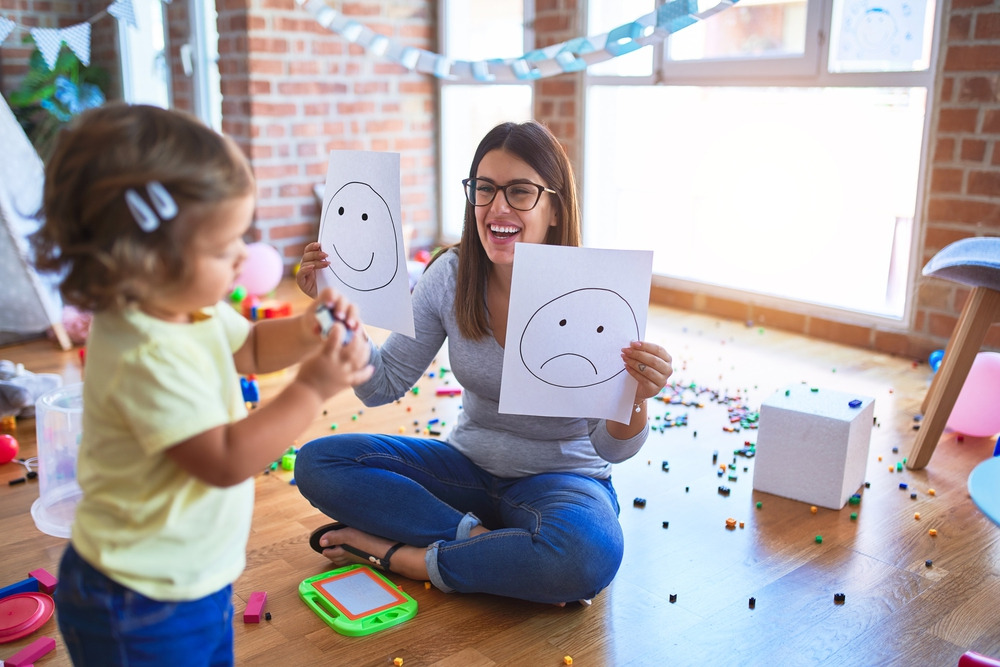
Create cards with photographs or drawings of faces showing different emotions. Children match faces, identify feelings, and discuss what might cause each emotion.
Why it works: Visual recognition helps preschoolers connect internal feelings to external expressions. When children see that “mad” looks like furrowed eyebrows and a frown, they better recognize anger in themselves and others.
Implementation: Use real photographs of diverse children showing genuine emotions rather than cartoon faces. Hold up cards during circle time and ask the children to name the feeling, make the face, and share times when they felt that way.
Feelings Check-In Routine
Establish daily opportunities for children to identify and share their current emotions using visual aids like emotion charts, mirrors, or color systems.
Why it works: Regular practice builds self-awareness and normalizes talking about feelings. Children learn that everyone has different emotions throughout the day and that feelings are acceptable to discuss.
Implementation: During morning circle, each child points to a face on an emotion chart showing how they feel. Teachers validate all feelings: “Thank you for sharing. It’s okay to feel frustrated sometimes.” This simple routine creates a culture where emotional expression is valued.
Emotion Charades and Drama Play
Children act out scenarios and emotions while others guess the feeling. This can include puppets, role-playing, or theatrical play.
Why it works: Physical expression helps children connect body sensations to emotions. When they act out “scared” with wide eyes and trembling hands, they recognize these signals in themselves.
Implementation: Use simple scenarios: “Show me how your face looks when you get a present,” “Act like you lost your favorite toy,” “Pretend you saw something scary.” Progress to more complex situations involving multiple emotions.
Emotion Books and Story Time
Read books specifically addressing emotions, pausing to discuss characters’ feelings, causes, and responses. High-quality emotion books show diverse characters experiencing and managing various feelings.
Why it works: Stories provide a safe distance for exploring difficult emotions. Children can discuss a character’s fear or anger without the vulnerability of sharing their own experiences.
Implementation: Ask open-ended questions: “How do you think she feels right now?” “What happened that made him angry?” “What could she do to feel better?” Connect stories to children’s experiences: “Have you ever felt that way?”
Calm-Down Strategies Practice
Teach and practice specific coping techniques when children are calm, so these tools are accessible during emotional moments.
Effective Techniques:
- Deep breathing exercises (smell the flower, blow out the candle)
- Counting slowly to five or ten
- Using a calm-down corner with soft items
- Squeezing stress balls or playdough
- Naming the feeling out loud
- Asking for a hug or help
Why it works: Emotional regulation requires practiced strategies. Children can’t access new skills during meltdowns; they need familiar tools established during calm periods.
Implementation: Practice breathing exercises during transition times. Create a cozy calm-down space children can use voluntarily. Model using strategies yourself: “I’m feeling frustrated, so I’m going to take three deep breaths.”
Activities for Feelings in Preschool Classrooms
Quality preschool programs weave emotional learning throughout the day rather than isolating it to one activity or lesson.
Emotion Art Expression
Open-ended art materials allow children to express feelings through color, texture, and form without pressure to create recognizable results. This process validates emotions and shows children they can release feelings safely through creativity rather than destructive behavior.
Feelings Music and Movement
Songs, dance, and movement activities help children explore emotions through rhythm and full-body expression. Music supports emotional learning, especially for children who struggle to verbalize feelings but can express them physically.
Cooperative Games Teaching Empathy
Cooperative games encourage turn-taking, communication, and awareness of others’ emotions. With teacher guidance, children learn to recognize peers’ feelings and respond supportively, building the foundation for empathy and healthy relationships.
Problem-Solving Role Play
Role play allows children to practice resolving common conflicts while considering everyone’s feelings. Playful, low-pressure scenarios help children internalize problem-solving strategies they can use during real emotional challenges.
Activities About Emotions for Kindergarten
As children approach kindergarten, emotional activities should increase in sophistication, addressing more complex feelings and nuanced situations.
Emotion Intensity Scales
Children learn that emotions vary in strength, using tools like a feelings thermometer or a 1–5 scale to distinguish between mild irritation and intense anger. This helps them choose coping strategies that match the intensity of the feeling and avoid overreacting to small frustrations.
Multiple Emotions Simultaneously
Older preschoolers begin to understand that more than one emotion can be felt at the same time, such as feeling excited and nervous or proud and disappointed. Recognizing this complexity builds emotional awareness and reduces black-and-white thinking.
Cause and Effect Emotion Scenarios
Children explore how different situations and intentions influence emotions by predicting how they might feel in various scenarios. This strengthens emotional reasoning and helps them understand that the same event can lead to different feelings.
Emotion Problem-Solving Journals
Pre-kindergarten children reflect on emotional experiences through drawing and dictation. Revisiting these journals helps them recognize growth and reinforces effective strategies for managing difficult emotions.
What Are the Emotions of a 4-Year-Old?
Four-year-olds experience particular emotional patterns related to their developmental stage. Understanding these typical emotions helps parents and teachers respond appropriately.
Common 4-Year-Old Emotional Patterns:
- Extreme emotions: Feelings are intense and all-consuming; small disappointments feel catastrophic.
- Rapid emotional shifts: Moving from joy to anger to laughter within minutes.
- Frustration with limitations: Anger when physical abilities don’t match imagination or when adults impose boundaries.
- Fear of separation and abandonment: Anxiety about parent departures despite previous comfort.
- Pride and shame: Growing awareness of success and failure, seeking approval.
- Beginning empathy: Genuine concern when friends are hurt, though self-focus dominates.
- Jealousy and possessiveness: Intense reactions to sharing attention, toys, or relationships.
These patterns are developmentally normal, not behavioral problems. The four-year-old brain simply hasn’t developed the regulation capacity for emotional moderation.
Teachers and parents support four-year-olds by validating intense feelings while teaching proportional responses: “I see you’re very upset the red cup is gone. It’s okay to feel disappointed. Let’s find a different cup you might like.”
How to Build Emotion Skills at Home
Parents are children’s first and most important emotional teachers. Simple daily practices build emotional intelligence more effectively than structured lessons.
Home Strategies:
- Talk about feelings constantly: during play, meals, car rides, and bedtime.
- Read emotion-focused books: Discuss characters’ feelings and choices.
- Validate rather than fix: When children are upset, resist immediately solving the problem; sit with feelings first.
- Create emotion-friendly language: “It’s okay to feel angry. Let’s take some deep breaths together.”
- Model emotional regulation: Narrate your coping: “I’m feeling frustrated, so I’m going to take a break.”
- Practice empathy: “How do you think your sister felt when that happened?”
- Establish calm-down routines: Consistent strategies children can use independently.
The key is making emotional conversation natural rather than forced. When you notice your child’s emotion, simply naming it creates awareness: “You seem really excited about going to the park” or “I notice you look worried. What’s on your mind?”
Common Mistakes in Teaching Emotions
Well-intentioned adults often undermine emotional development through approaches that seem helpful but create problems.
Avoid These Pitfalls:
- Dismissing “negative” emotions: Saying “don’t be sad” teaches children that certain feelings are unacceptable.
- Over-praising emotional control: “Good job not crying!” suggests emotions should be hidden.
- Rescuing too quickly: Immediately fixing problems prevents children from developing frustration tolerance.
- Using timeout for emotional expression: Isolating children when they most need connection teaches that emotions drive people away.
- Adult-level regulation: developmentally impossible; preschool brains cannot regulate in the same way that adult brains do.
- Gendered emotion: “Big boys don’t cry” or “girls should be nice” creates harmful emotional restrictions
Instead, communicate that all feelings are temporary, manageable, and okay to experience. The goal isn’t eliminating difficult emotions; it’s helping children develop healthy ways to experience and express them.
When Emotional Development Needs Extra Support
Some children struggle significantly more than peers with emotional regulation, despite consistent teaching and support. Early intervention dramatically improves outcomes.
Signs That Expert Assistance Could Be Helpful:
- Extreme, prolonged tantrums beyond age 4 (lasting 15+ minutes regularly).
- Frequent aggression causing peer rejection or safety concerns.
- Inability to transition between activities without major distress.
- Persistent anxiety interfering with daily functioning.
- Emotional responses severely disproportionate to situations.
- Despite consistent support, emotional control has not improved.
These patterns may indicate sensory processing differences, anxiety disorders, developmental delays, or other challenges requiring specialized intervention. Early childhood mental health professionals can assess and provide targeted support.
Emotions and School Readiness
Kindergarten teachers consistently report that emotional regulation is more critical for school readiness than letter recognition or counting. Children who can manage frustration, follow directions, and recover from setbacks are better prepared to learn. Without these skills, academic knowledge alone is insufficient.
This is why quality preschool programs prioritize social-emotional development alongside academics. At Truth Preschool Academy in Ontario, CA, emotional development is the foundation of learning. Credentialed teachers establish safe spaces where families work together to develop emotional competencies and children are assisted in overcoming emotional obstacles.
Through daily interactions, validating feelings, modeling coping strategies, and coaching through conflict, children develop emotional competence over time. Our faith-based approach combines Christian values with research-based practices to support the whole child: mind, body, and spirit. These skills strengthen learning and support long-term success.
Schedule a tour to see how we integrate emotional learning throughout our day, creating strong foundations for both kindergarten readiness and emotional well-being.
Frequently Asked Questions
What are emotions for preschoolers?
Preschool emotions include the six basic feelings children ages 3-5 must learn: happy, sad, angry, scared, surprised, and disgusted. Children need to identify these emotions in themselves and others, express them appropriately, and develop simple coping strategies for difficult feelings.
What are the 20 emotions for kids?
The 20 essential emotions for young children include happy, sad, angry, scared, surprised, disgusted, excited, proud, embarrassed, jealous, worried, frustrated, disappointed, lonely, shy, loved, confused, silly, calm, and brave. Preschoolers typically master basic emotions first before understanding more complex feelings.
What are some emotional activities for preschoolers?
Effective emotional activities include feelings face matching games, daily emotion check-ins, emotion charades and drama play, reading emotion-focused books, practicing calm-down breathing techniques, creating emotion art, feelings songs and movement, and cooperative games building empathy. Quality programs integrate these throughout daily routines.
What are the emotions of a 4-year-old?
Four-year-olds experience intense, quickly changing emotions, including frustration, fear of separation, pride and shame, emerging empathy, and jealousy over attention. These patterns are developmentally normal for this age.
How can I help my preschooler express emotions without hitting?
Teach and practice emotion words when calm, validate all feelings while setting behavior limits (“It’s okay to be angry, not okay to hit”), provide alternative expressions like using words or squeezing stress balls, and coach during conflicts with phrases like “Use your words to tell him you don’t like that.” Consistent practice builds neural pathways for verbal expression.
What books teach emotions to preschoolers?
High-quality emotion books include “The Feelings Book” by Todd Parr, “In My Heart” by Jo Witek, “The Color Monster” by Anna Llenas, “When Sophie Gets Angry” by Molly Bang, and “Glad Monster, Sad Monster” by Ed Emberley. Choose books showing diverse characters experiencing and managing various feelings authentically.
When should my preschooler’s emotional growth be a concern?
Seek professional evaluation if your preschooler over age 4 has frequent, intense tantrums, persistent aggression, extreme difficulty transitioning, ongoing anxiety, or little improvement in emotional control despite support. Early intervention leads to significantly better outcomes.
How do faith-based preschools teach emotional development?
Faith-based preschools teach the same emotional identification, regulation, and expression skills as secular programs but within a framework of Christian values, helping children understand that God created emotions, feelings aren’t good or bad, and managing emotions honors others. This approach provides additional meaning while using research-based techniques.
- Phone: (909) 704-7575
- Address: 602 N Virginia Ave, Ontario, CA 91764
-
Hours: Mon-Fri: 6am - 6pm
Sat-Sun: Closed - info@truthpreschoolacademy.com
Truth Preschool Academy All Rights Reserved. Privacy Policy