Get Directions | (909) 704-7575 | Mon-Fri: 6am - 6pm
-
Give us a Call (909) 316-8257
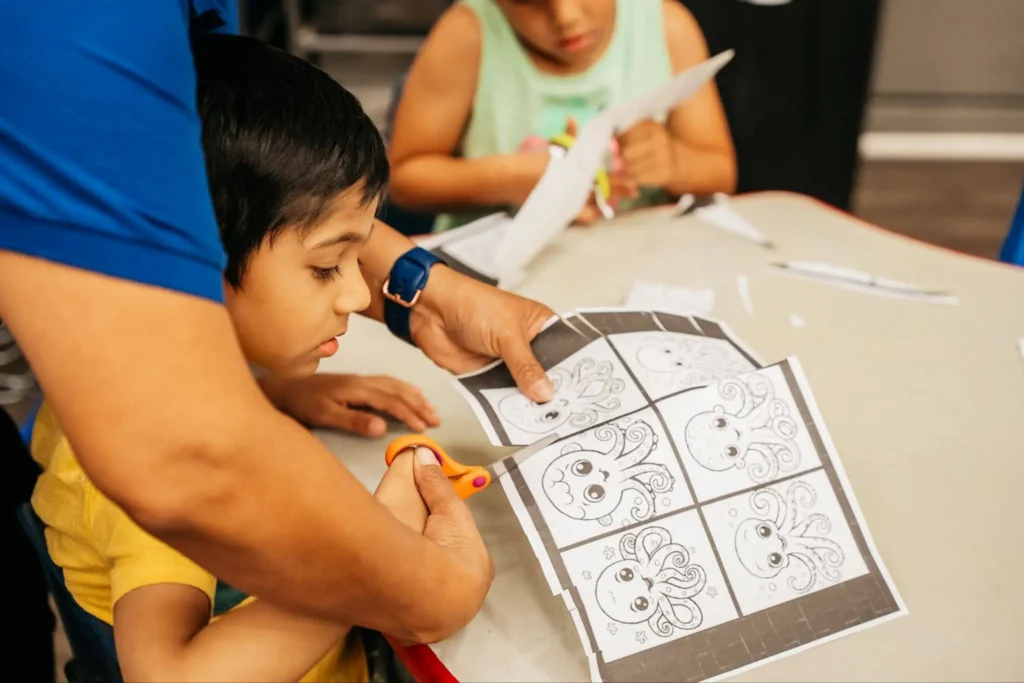
Toddler Development Milestones: What to Expect Between Ages 2 and 3
Ms. Danielle
It’s easy to fall into comparing your toddler to another kid at pickup — the one who’s already stringing sentences together while yours is still pointing and grunting. Comparison rarely settles the worry it creates.
A clearer way to think about toddler development milestones is the way the CDC actually defines them: skills that at least 75% of children can do by a certain age, not a race every child runs at the same pace. Knowing the real benchmarks gives you something more useful than a comparison — an actual reference point.
Here’s what most toddlers are doing socially, verbally, physically, and cognitively at 2 and 3 years old, according to the CDC, and what to do if something seems off.
Social and Emotional Milestones at 2 and 3
By age 2, most toddlers start noticing when others are hurt or upset — pausing or looking sad when someone cries — and they look to a caregiver’s face for cues on how to react in an unfamiliar situation.
By age 3, that awareness extends further: most children notice other children and join in play rather than just playing alongside them, and most can calm down within about 10 minutes after a parent leaves — including at a child care drop-off specifically, per the CDC’s own example.
Language and Communication Milestones at 2 and 3
At 2, most toddlers point to something in a book when asked (“Where’s the bear?”), put two words together (“more milk”), point to at least two body parts on request, and use gestures beyond a simple wave or point, like blowing a kiss.
By 3, language usually takes a real leap. Most children can hold a back-and-forth conversation with at least two exchanges, ask who/what/where/why questions, name an action happening in a picture, say their own first name, and talk clearly enough for others to understand most of the time.
Cognitive and Physical Milestones at 2 and 3
Cognitively, most 2-year-olds can hold an object in one hand while using the other (like unscrewing a lid), figure out switches and buttons on a toy, and play with two toys together in a way that shows early pretend play. Physically, most can kick a ball, run, walk up a few stairs, and eat with a spoon.
By 3, most children can draw a circle when shown how and avoid touching something they’ve been warned is hot. Physically, most can string large beads, put on a loose piece of clothing by themselves, and use a fork.
What to Do If You Have a Concern
None of these milestones are a pass/fail test, and the CDC is explicit about that: they represent what most children — not all — can do by a given age. If your toddler hasn’t reached one or more of these, or has lost a skill they once had, the CDC’s guidance is simple: don’t wait, and talk with your child’s doctor about developmental screening.
Teachers who see your child every day are often the first to notice a pattern worth mentioning, precisely because consistent, attentive relationships are the foundation of good early childhood care, according to NAEYC. A quick conversation at pickup can catch something small before it becomes a bigger question.
Growing at Their Own Pace
Milestones are a reference point, not a scoreboard. Most toddlers reach these skills within a range, not on a fixed timeline, and a wide range of perfectly typical development falls inside that window.
What matters day to day is having teachers who actually track these patterns and loop parents in early rather than waiting for a scheduled conference. If you’d like to see how Truth Preschool Academy’s toddler program supports these stages in real time, schedule a tour and ask the teaching team what they’re watching for at your child’s age.
FAQ
What are developmental milestones?
Skills in play, learning, speech, behavior, and movement that most children (75% or more) can do by a certain age, according to the CDC.
What should a 2-year-old be able to do?
Most 2-year-olds can say two-word phrases, point to body parts, kick a ball, and play with two toys together in a simple pretend scenario.
What should a 3-year-old be able to do?
Most 3-year-olds can hold a short back-and-forth conversation, ask who/what/where/why questions, draw a circle when shown, and use a fork.
What should I do if my toddler isn’t meeting a milestone?
Talk with your child’s doctor and ask about developmental screening. Don’t wait to see if it resolves on its own.
Do all toddlers develop at the same pace?
No. Milestones describe a typical range, not a fixed timeline, and normal development varies from child to child.
- Phone: (909) 704-7575
- Address: 602 N Virginia Ave, Ontario, CA 91764
-
Hours: Mon-Fri: 6am - 6pm
Sat-Sun: Closed - info@truthpreschoolacademy.com
Allow media cookies to view this video or map.
Truth Preschool Academy All Rights Reserved. Privacy Policy
Powered by AMARQUEZ